THE HUMAN QUESTION
Why this game was made.
Afterlight repeats the experiment described in the author’s Facebook post: hand over creative control, ask for a playable game, then request improvements without prescribing the gameplay. It uses the revised prompt below, which includes release notes, public design motivations and testing from the beginning. The intention is to make the experiment inspectable—not to assume that a longer changelog means a better game.
The Facebook post’s criticism—relaxing but somewhat boring play, mild improvements and repeated-feeling procedural levels—describes the original Lumenwake experiment. It motivates trying again with a clearer record of what changed and why; it is not evidence that Afterlight has solved those problems.
THE ORIGINAL BRIEF
The prompt.
Imagine, design and implement a visually striking single-player game that runs in an HTML canvas. You have full creative authority over its gameplay, world, mechanics and presentation. Make those decisions yourself without asking me for gameplay direction. Add a button that opens the release notes. For every release, record its version and actual date and time with timezone. Describe the game in the initial entry and changes from the preceding version in subsequent entries. Preserve earlier entries. Record concise design motivations while choosing and implementing the initial game and each improvement: the problem or opportunity, chosen approach, expected benefit and relevant tradeoffs. Distinguish expectations from verified results. Implement and test each revision, update the release notes, and provide a ready-to-publish ZIP with brief publishing instructions.
Verbatim initial game request, recovered from the creation conversation.
Then, ask it to improve.
Improve further.
WHAT THE AI MADE
A small world with its own rules.
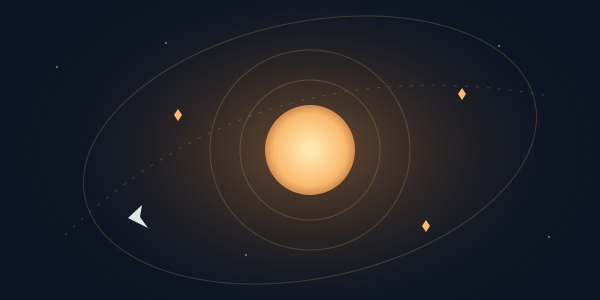
Gather up to three embers and return fifteen to the central sun across three tides. Flare, dash, avoid shades and prisms, and optionally link three constellation beacons.
The human specified the platform and delegated the game design. The current version includes later AI-chosen iterations. Functional checks and the author’s subjective reaction are different kinds of evidence.
Recorded design decisions →Full game release archive →